


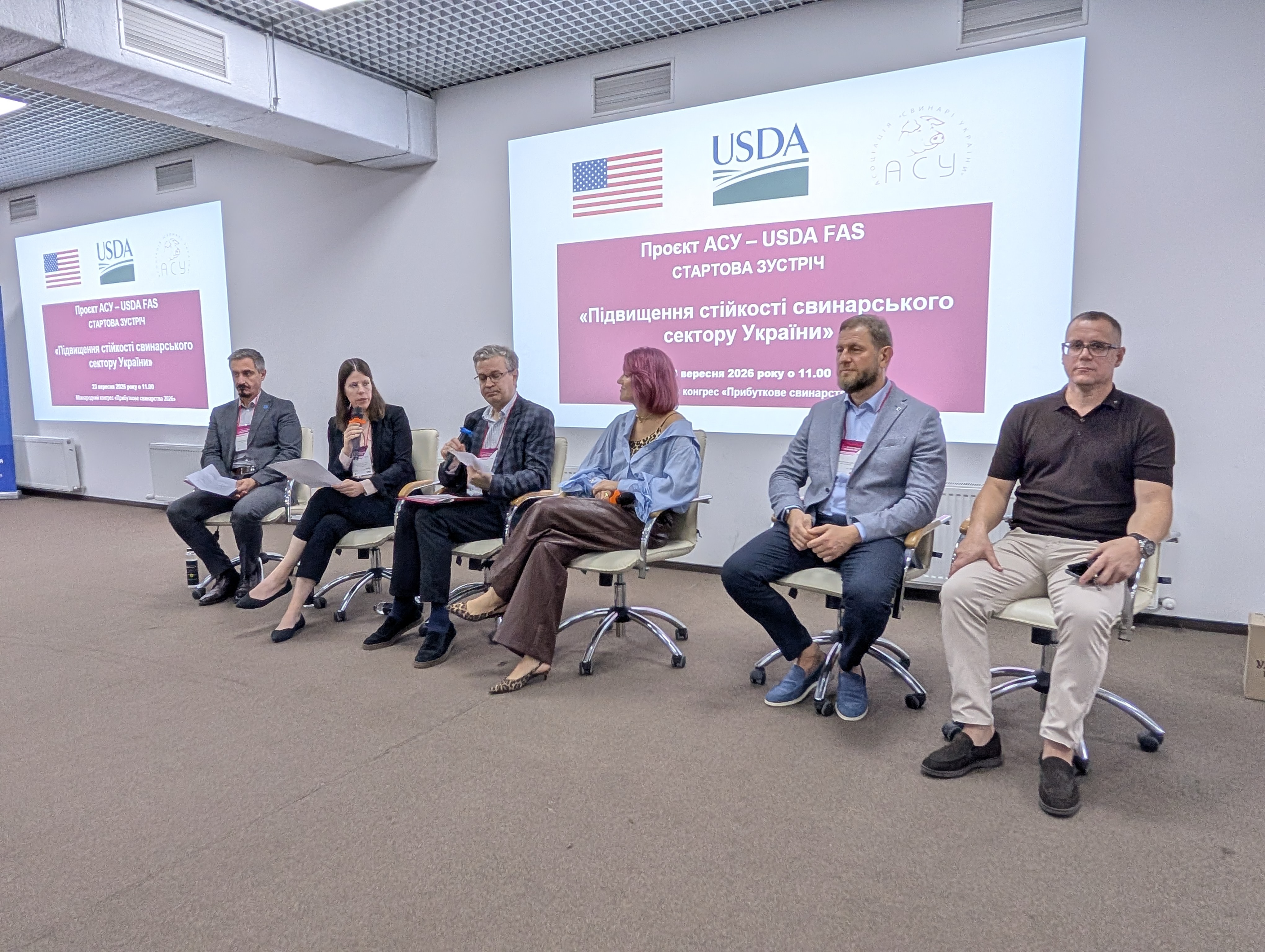
The new initiative continues the cooperation launched under the previous project, which was completed at the end of 2024.
“The previous project delivered tangible results: stronger biosecurity, improved animal husbandry practices and more structured advisory support for the sector. Today, I am pleased to announce that our cooperation is not ending — it is moving into a new phase. USDA is supporting a new initiative with the Association of Ukrainian Pig Breeders aimed at further strengthening Ukraine’s pig sector, with a focus on innovation and capacity building,” said Megan Franchik, Agricultural Attaché at the U.S. Department of Agriculture.
According to her, the project reflects the priorities repeatedly identified by the industry itself: modern disease control, responsible use of antimicrobials, development of training and advisory systems, as well as practical support for farms in biosecurity, herd performance, workforce organisation and benchmarking.
“This initiative is intended to be practical and producer-focused. Its success will depend on your participation and feedback, which is extremely important to us. It is also part of the broader relationship between the United States and Ukraine, strengthening animal health, food security and our shared economic ties,” Megan Franchik emphasised.
Oksana Yurchenko, President of the Association of Ukrainian Pig Breeders, stressed that the project will primarily have a practical focus for producers. Biosecurity will remain one of its core areas, but it will be complemented by animal welfare, technical audits, expert consultations and other practical measures designed to help farms improve their production practices.
“We will continue working on biosecurity, but we will also add an animal welfare component and other practical measures. If a farm can receive a technical audit and professional recommendations, that will certainly be valuable. We will also continue moving towards responsible antibiotic use, including through training programmes for future professionals who will work on our farms,” Oksana Yurchenko said.
Another important area will be strengthening the capacity of the competent authority in ASF control. The project provides for the development of standard operating procedures, practical training and simulation exercises for specialists, including on regionalisation, humane killing, ASF control in wildlife and actions to be taken in the event of an outbreak.
Ihor Lotskin, Director of the Department of Food Safety and Veterinary Medicine at the State Service of Ukraine on Food Safety and Consumer Protection, emphasised that the State Service will be directly involved in implementing the project.
“When ASF outbreaks unfortunately occur, we all know how things often happen: one person says to do it one way, another says to dig a pit somewhere else, while someone else recommends a particular method of killing. It would be far better to standardise these actions through standard operating procedures that clearly define who should act, when, under what circumstances and how. This will provide transparency for public authorities and clarity for operators,” Ihor Lotskin said.
The participants also discussed laboratory diagnostics. Dmytro Masiuk, Director of the Research and Diagnostic Centre for Biosecurity and Environmental Control of Agro-Industrial Resources at Dnipro State Agrarian and Economic University, stressed that antimicrobial resistance is a global problem and that laboratory research should help provide a better understanding of resistant strains, resistance genes and the factors affecting animal health.
“Antimicrobial resistance is a creeping pandemic. We need to understand that antibiotics must be used responsibly, and laboratory testing will help us manage this process. This is not only about five-year studies of antibiotic use, but also about resistance genes that need to be detected, analysed and taken into account in farm management,” Dmytro Masiuk explained.
The project will also address technologies that can help reduce dependence on antibiotics. These include vaccination, autogenous vaccines, probiotics, acids, bacteriophages and other solutions, as well as the use of modern research methods, including microbiome analysis, metagenomics and metabolomics.
Another practical area will be a reproduction school and individual advisory and technical support for farms. According to Oleksandr Baban, an expert in pig reproduction, reproduction remains one of the key challenges for the pig sector because it directly affects production performance.
“We are facing major challenges, and we need to meet them properly. Reproduction is also a challenge. We do not want simply to go through a checklist of what is wrong on a farm; we want to work with the real problems producers are facing today,” Oleksandr Baban stressed.
Planned tools include online and in-person training, individual consultations, technical audits, laboratory support, international study tours and hands-on work with experts. The project will be implemented through September 2027.
The International Congress “Profitable Pig Production” is one of the largest industry events not only in Ukraine but also beyond its borders. It is a platform for open discussion of all issues affecting Ukraine’s pig sector. Participants include pig producers, leading Ukrainian and international specialists, government representatives and experts from international organisations. The event is organised by the Association of Ukrainian Pig Breeders, the Ukrainian Agri Council and agricultural consulting company DYKUN.