


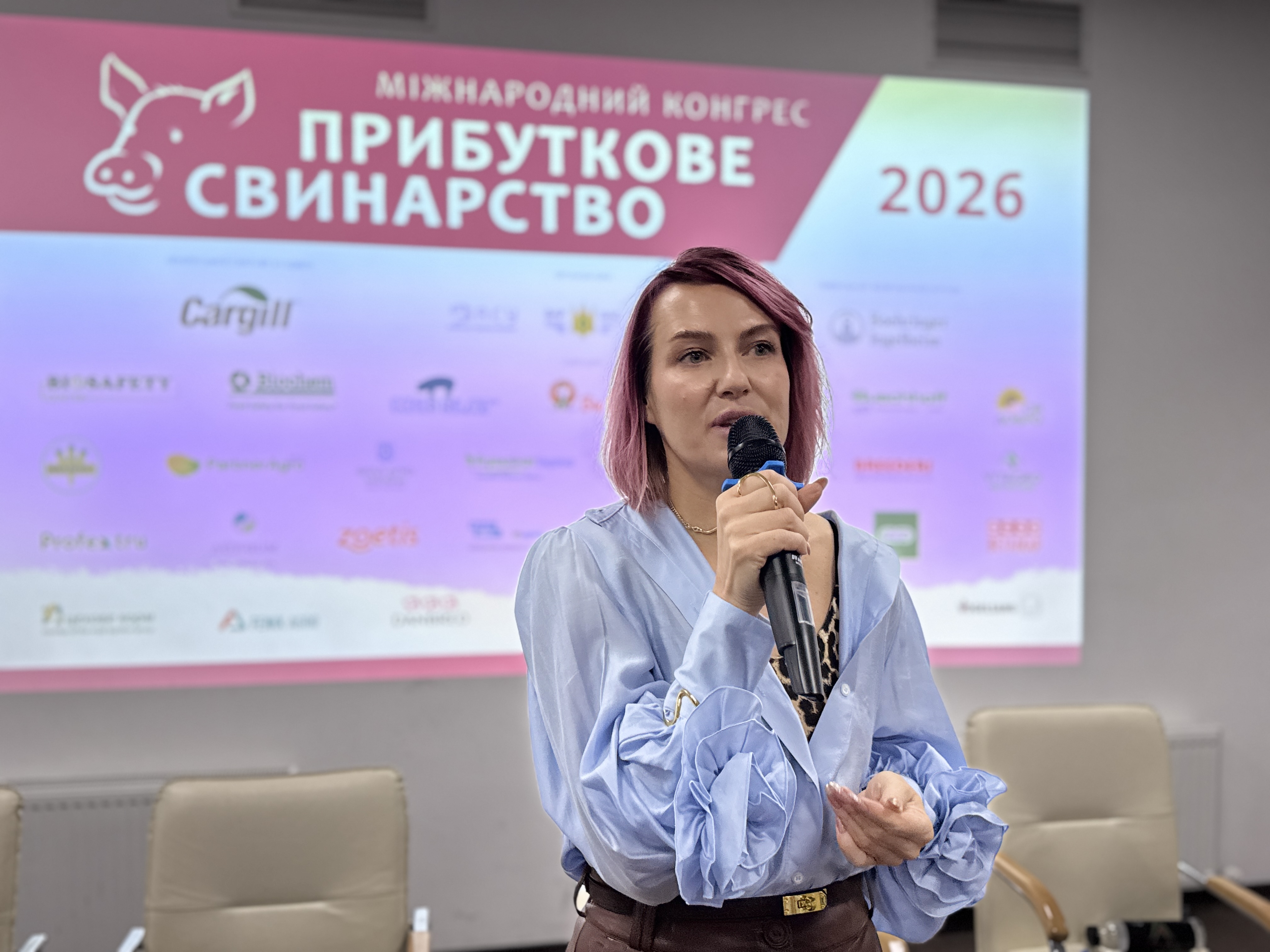
This year’s programme featured two parallel sections — “Management and Technology” and “Health and Veterinary Medicine.” Participants discussed issues that directly affect pig farms today: government support, new markets, animal identification, employee reservation from mobilisation, feed solutions, energy independence, automation, genetics, biosecurity, veterinary control, reproduction and herd health.
In the “Management and Technology” section, key topics included industry development, regulatory changes, support for pig businesses and adaptation to European requirements. Particular attention was paid to ongoing work to open new markets for Ukrainian pork.
Ihor Lotskin, Director of the Department of Food Safety and Veterinary Medicine at the State Service of Ukraine on Food Safety and Consumer Protection, spoke about the audit of Ukraine’s state control system for exports of pork products to the EU. For now, the focus is primarily on heat-treated canned products, but this area is viewed as an important first step in further dialogue with the European Union:
“This is the first step. The European Commission selected what it considers the most protected category of products — heat-treated canned products. For us, however, this creates an opportunity to continue the dialogue on opening other categories. Even though we are talking about heat-treated products, the requirements remain extremely high: they were essentially examining us down to the smallest detail.”
Animal identification was another important topic. Danylo Pavlychenko, a member of the Verkhovna Rada Committee on Agrarian and Land Policy, spoke about the development of a new legislative concept intended to regulate identification methods and responsible parties more clearly. For pig farms, one particularly important issue is retaining tattooing as a method of pig identification.
A separate part of the section focused on modern pig farm practices. During the “Pig Farm 2030 in Practice” panel, participants discussed automation, animal welfare, modernisation, genetics, workforce management and digital solutions. The focus was on tools that help farms exercise more precise control over production, reduce losses and manage resources more effectively.
The discussion on pig feeding — “Feed Solutions for Optimising Production Costs” — was equally practical. Participants discussed the grain market, on-farm feed production, feed efficiency, adapting rations to raw material prices and making better use of farms’ own feed resources. Feed remains one of the largest components of production costs in pig farming.
The “Production Optimisation” block covered energy efficiency and on-farm power generation technologies, genetics, financial management, feed mill construction and biosecurity as opportunities to improve operational efficiency. Business representatives shared practical experience of controlling costs, assessing the effectiveness of different solutions and working with data so that it supports day-to-day production management.
Another part of the programme was the launch meeting of the new “Strengthening the Resilience of Pig Production in Ukraine” project, which the Association of Ukrainian Pig Breeders will implement with support from the U.S. Department of Agriculture. The project is aimed at strengthening the resilience of Ukraine’s pig sector and will cover several areas: biosecurity, animal welfare, responsible antibiotic use, laboratory diagnostics, support for the competent authority in ASF prevention, a reproduction school, technical audits and individual consultations for farms.
“This initiative is intended to be practical and producer-focused. Its success will depend on your participation and feedback, which is extremely important to us. It is also part of the broader relationship between the United States and Ukraine, strengthening animal health, food security and our shared economic ties,” said Megan Franchik.
In the “Health and Veterinary Medicine” section, the focus was on issues that are becoming increasingly important in the day-to-day operation of pig farms: new veterinary rules, disease control, ileitis, porcine circovirus infection, laboratory diagnostics, reproduction, sow longevity and the use of antimicrobial veterinary medicinal products. A separate practical component was an interactive session in which Congress participants had an opportunity to ask leading industry experts questions directly and receive advice on specific situations faced by pig farms.
Key issues for the sector were also addressed by Oleksii Klymenok, Head of the Department for the Organisation of Anti-Epizootic Measures at the State Service of Ukraine on Food Safety and Consumer Protection. He outlined major changes in veterinary regulation to which the sector will have to adapt in the coming years. These included updated approaches to disease monitoring, quarantine, epidemiological investigations, animal keeper responsibilities and risk-based controls.
Particular attention was paid to ASF, zoning, confirmation of farm status for animal movements, timely notification of suspected disease and production monitoring.
“If a farm wants to move animals outside a zone, it must confirm that it is free from ASF: undergo an inspection, assessment and laboratory testing. The next stage is zoning. We say that we want to establish trade with the European Union, but then we need to demonstrate which zones have been defined in Ukraine and how movements within them are controlled,” Oleksii Klymenok said.
His presentation also covered animal welfare, including requirements for the keeping and transport of pigs, which are gradually becoming part of everyday farm operations. The topic generated considerable interest among practising veterinarians: after the presentation, participants actively joined the discussion, asked questions and shared their own experience of implementing such requirements at their businesses.
The veterinary section also featured expert presentations on modern approaches to ileitis control, PCV2, laboratory diagnostics, reproductive problems and sow longevity. Experts discussed early disease detection, diagnosis of hidden threats, revision of vaccination programmes, systematic management of reproduction and the economic value of a healthy, productive herd.
Overall, this year’s Congress demonstrated just how broad the range of challenges facing pig businesses has become. The sector is simultaneously dealing with new veterinary requirements, the need for energy independence, cost pressures, workforce challenges, biosecurity, the search for new markets and production modernisation. Once again, the International Congress “Profitable Pig Production” served as a platform for professional dialogue, the exchange of practical experience and the search for solutions that help Ukraine’s pig sector adapt to new conditions and move forward.