


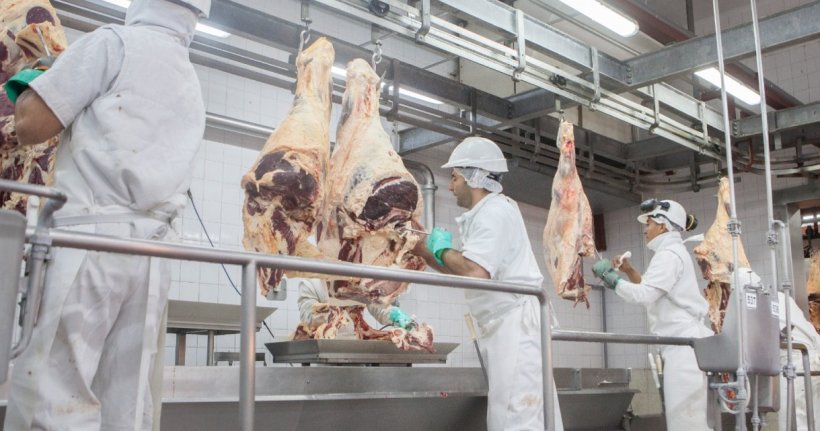
Argentina’s Secretariat of Agriculture, Livestock and Fisheries under the Ministry of Economy presented the updated Electronic Slaughter Control System (CEF) at the 2026 Rural Expo.
Representatives of meat industry associations and producer organisations from different regions of the country were introduced to the new version of the system.
The aim of the modernisation is to simplify the management of slaughter data, strengthen government oversight and ensure greater transparency throughout the meat production and marketing chain.
Before the system is rolled out on a large scale, the updated CEF version has been introduced on a pilot basis at 12 slaughter facilities.
The plants selected for testing were chosen according to several criteria in order to assess the system under different production conditions. These included:
- the geographical location of the facility;
- processing volume;
- the equipment supplier previously used by the plant;
- the type of transit authorisation — provincial or federal.
This approach is intended to assess the performance of the updated system across different types of slaughter facilities before nationwide implementation begins.
Once the pilot phase is completed, the update is expected to be rolled out to 480 facilities across Argentina.
The system is expected to cover the slaughter of all animal species, allowing control procedures to be standardised at the national level and data on slaughterhouse operations to be centralised.
CEF is intended to become one of the key digital tools for supervising the meat industry and to provide more accurate tracking of actual slaughter volumes.
The Electronic Slaughter Control System can effectively be compared to a “black box” that automatically collects and stores information on slaughtered animals.
It consists of weighing equipment and cameras. During slaughter, the system records the weight of the animals and captures corresponding images, after which the information is stored on a dedicated device.
As a result, control is based not only on documentation submitted by the slaughterhouse itself, but also on objective data recorded automatically.
This digital tracking is expected to help government authorities monitor slaughter volumes more accurately, improve traceability and reduce opportunities for manipulation of production data.
The modernisation of CEF forms part of the broader shift of Argentina’s meat industry towards digital control tools, with automated data collection intended to deliver more efficient administration, stronger oversight and greater market transparency.
PigUA.info, based on materials from 3tres3.com